

There is a choice most people never make.
Not because they lack the character to make it. Not because they are not paying attention or not trying or not oriented toward something real. But because no one ever told them the choice was there. Because the option was never named. Because everything in the culture around them was designed to help them find something good and call it enough and move on.
The choice is this: good or the highest good.
They are not the same thing.
Good is real. This needs to be said first and said clearly. Good is not a consolation prize. Good work, good lives, good intentions aimed at good ends have produced everything worth preserving in human civilization. The hospitals and the schools and the art and the bridges and the movements that bent the arc of history toward justice. All of it came from people who chose good over its absence. That is not a small thing. That is most of what has held the world together.
But good has a ceiling.
And the highest good does not.
This is the distinction that changes everything once you have seen it. Good is a standard defined by comparison. Better than what came before. Better than what others are doing. Better than what the situation requires. Good is measured horizontally against other things that exist inside the world.
The highest good is measured vertically against the source of all things. It does not ask whether this is better than what others are doing. It asks whether this is the most aligned version of what it could be. Whether it reflects something true. Whether it is the closest that human hands and minds are capable of getting to what the source of all things would recognize as its own.
That is a different standard entirely.
Most people live their entire lives inside the horizontal.
They improve. They grow. They aim higher than they did before. They become genuinely better at what they do and genuinely more useful to the people around them. And all of this is good. All of it matters. None of it should be dismissed.
But improvement is not orientation. Getting better is not the same as pointing at the highest thing. You can spend a lifetime getting better at pointing in the wrong direction and arrive at the end of it more skilled and more accomplished and more admired and still have the quiet sense that you missed something. That the direction, however well traveled, was not the highest direction available.
The soul knows the difference between good and the highest good even when the mind has made peace with good and called it enough. It registers the gap not as failure but as the specific longing of something that was made for more than it has been aimed at.
That longing is not a problem to be solved. It is a signal to be followed.
The highest good asks more than good does.
This is why most people do not choose it. Not consciously. It is not that they look at the highest good and reject it. It is that the full weight of what it asks is never laid out plainly enough for them to understand what they are declining.
Here is what it asks.
It asks that every standard you hold be held against the source of all things rather than against what the room expects or the market rewards or what would be easier to explain or faster to produce. It asks that you close the comfortable exits. That you stop accepting good enough when better is possible. That you ask of every choice, every output, every direction: is this the highest most aligned version of what it could be or am I stopping short because stopping short is easier?
It asks that you never mistake arrival for destination. That you treat every achievement as a place to pass through on the way to something higher. That you remain perpetually oriented upward even when upward is harder than across and slower than what the moment rewards.
It asks that you hold the standard even when no one is watching. Even when the client would not know the difference. Even when the audience would not notice. Because the standard is not for them. The standard is for the source. And the source notices everything.
This is not perfectionism.
Perfectionism is fear wearing the clothes of high standards. It is oriented inward, toward the self and its need to be beyond criticism. It produces paralysis and anxiety and work that is technically accomplished and spiritually empty.
What the highest good asks is the opposite of perfectionism. It is oriented outward and upward. Toward something larger than the self. Toward the source. It produces not paralysis but clarity. Not anxiety but steadiness. The specific steadiness of a person who knows what they are aimed at and does not need the room to confirm it.
The highest good is not a harder version of good. It is a different orientation entirely. One that does not produce more stress but less. Because you are no longer measuring yourself against everything around you. You are measuring yourself against the one standard that does not shift and does not go out of fashion and does not change its requirements based on who is watching.
The gap between good and the highest good is where most lives are quietly lost.
Not dramatically. Not in a single wrong turn. In the accumulation of choices that were good enough. In the standard quietly lowered a hundred times in a hundred small moments until the lowered standard becomes the only standard anyone can remember. In the direction that was real and worthy and genuinely pointed at something true but stopped short of the highest thing available because the highest thing was harder and the good thing was right there and already impressive by every measure anyone was applying.
This is the wound. Not the absence of good. The presence of good mistaken for the highest good.
The cure is not to abandon what is good. It is to hold it up against a higher light and ask honestly whether it is the most aligned version of what it could be. Whether the distance between where it points and where the source is has been closed as far as human hands are capable of closing it.
Usually it has not.
Usually there is further to go.
And the willingness to go further, past the point where good would have been accepted and celebrated and rewarded, past the comfortable stopping point that everyone else would have recognized as enough, is the difference between a life aimed at good and a life aimed at the highest good.
You already know the difference.
You have felt it. In the moments when you pushed past the point where good would have been enough and found something on the other side of that threshold that had a different quality to it. A different weight. Something that felt less like achievement and more like alignment. Less like you made something and more like something true came through you.
That is the highest good making itself known.
It is always available. It is always the next question. It does not require a different life or a different set of circumstances or a different kind of person than the one you already are.
It requires only the willingness to hold everything up against the highest standard available and refuse to stop short of it.
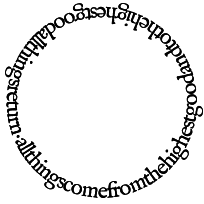
All things come from the highest good and to the highest good all things return.
Good is real. Honor it.
But do not mistake it for the destination.
The destination is higher than that.
And you already know it.
✦


