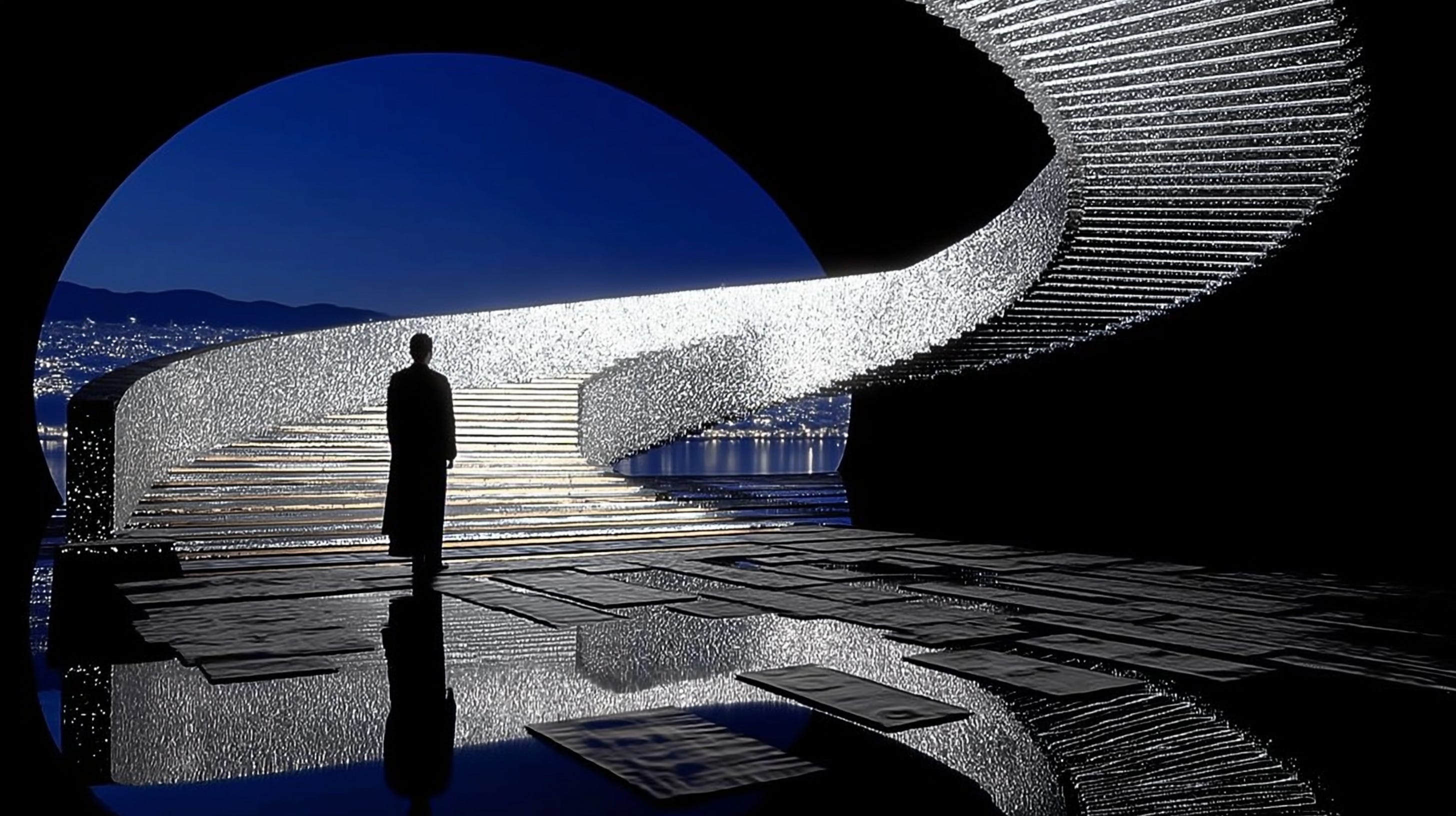
The staircase has always been there.
Not hidden. Not locked. Not reserved for a particular kind of person. It stands in plain sight, at the edge of almost every ordinary moment, and almost everyone has seen it. The version of the work that is more honest. The version of the life that is more deliberately aimed. The interior standard that, if actually held, would change everything about how a day is spent.
People see it. That is not the question.
The question is why, having seen it, most people turn around.
The answer the culture offers is capacity. People are busy. People are tired. The distance between seeing the staircase and climbing it is long, and real life has real demands, and the highest version of everything is not available to everyone in every moment.
This is true as far as it goes.
But it does not go far enough. Because the pattern is not people failing to climb in moments of genuine exhaustion. The pattern is people deciding, quietly and often without realizing it, that the staircase is not really for them. That good enough is the appropriate destination. That the ceiling, wherever it has settled, is the natural height of things. And then building a life around that decision without ever having made it explicitly.
This is what the culture has done. Not dramatically. Gradually. Through the slow reframing of comfort as wisdom, of stopping short as balance, of the lowered standard as maturity. The ceiling has dropped so incrementally, and so universally, that it has come to feel like the sky.
The person who begins to climb does not feel like they are reaching toward something available. They feel like they are doing something unusual. Something that requires justification. And the people around them, who have made their peace with the ground floor, often confirm that feeling.
This is the environment in which the orientation toward the highest good has to take root and hold.
Seeing the staircase is not the same as climbing it.
That gap, between seeing and choosing, is where most lives are actually decided. Not in moments of dramatic moral weight. In the ordinary moments when the easier version is right there and the harder version is one step further and the difference between them is real but invisible to anyone watching.
In those moments the question is not whether you know what better looks like. You do. Everyone does. The question is whether the direction toward it has become an actual commitment, or whether it has remained a preference. Something valued in principle but not held as the operating standard in practice.
A preference changes when the cost gets high. A commitment does not.
Orientation toward the highest good is a commitment. Not because it demands perfection. Because it demands that the direction stay fixed even when the road is harder than expected. Even when the room would accept the lesser version. Even when no one would notice the difference except you.
It demands that seeing and choosing become the same thing. That the interior knowledge of what better means gets translated into an actual operating standard and held there, not as an aspiration, but as the baseline.
This is the entire difference between a life that moves and a life that ascends.
There is a dimension of this that most writing on high standards misses entirely.
The relational dimension.
If you are oriented toward the highest good, you will spend most of your life alongside people who are not. Not because they are bad people. Not because they lack intelligence or character or genuine desire to live well. But because the orientation is not the default setting, and the people you love, work beside, and learn from will, most of them, be standing at the bottom of the staircase with no particular intention of climbing.
How you hold yourself toward those people is not separate from the orientation. It is one of its highest expressions.
The highest good includes how you treat the people who do not see what you see. Whether you carry the orientation as a credential that separates you from them, or as something you received without earning, and are therefore responsible for offering gently and without pressure to the people around you.
Superiority is not a higher standard. It is the highest standard applied only to the self and used as a measure of distance from others. The orientation turned inward and weaponized.
The actual standard includes the person standing at the bottom who is not climbing. It asks not what you think of them, but what you offer them. Not whether they are keeping up, but whether you are making the staircase look like somewhere worth going.
Kindness is not the softening of the standard.
This needs to be said because it is the most common misunderstanding. That there is a tension between holding the highest standard and treating others with genuine warmth. That rigor and kindness pull in opposite directions.
This is wrong.
Kindness, real kindness, not politeness, not the managed warmth of someone keeping the peace, but genuine care for another person’s movement toward the good, is part of the highest standard. It is not the softening of the orientation. It is one of its clearest expressions.
Because the highest good is not only a standard for what you produce. It is a standard for how you exist alongside other people. And that is one of the most demanding applications of the orientation available. It requires patience. The specific patience of someone who knows the orientation cannot be given, only received, and who is willing to keep offering it for as long as it takes. It requires the absence of superiority, not as a performance but as an actual interior condition. It requires the clarity to distinguish between kindness that serves someone’s growth and kindness that merely makes you easier to be around.
These are high demands. They are part of the climb.
The staircase does not go away.
Everyone sees it. The choosing is what separates the people who ascend from the people who build comfortable lives on the ground floor and call it wisdom.
And the choosing, once made consistently enough to become the actual operating standard, extends in every direction. Into the work and the output and the standard held in private with no one watching. Into the relationships with the people around you and the quality of attention you bring to their becoming as well as your own. Into the way you hold yourself toward the people who are not climbing, whether as someone who has found something they have not, or as someone who has been given something and knows it.
The path toward the highest good is not a solitary path. It moves through the world and through the people in it. And every person on it who holds the standard with genuine kindness toward those who do not, every person who makes the orientation look like an opening rather than a credential, is extending the staircase further than it would otherwise reach.
That extension is part of what you are for.
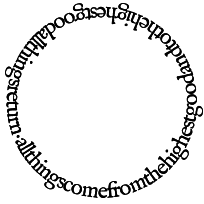
All things come from the highest good and to the highest good all things return.
The staircase has always been there. The question, always, is whether you are climbing.
✦